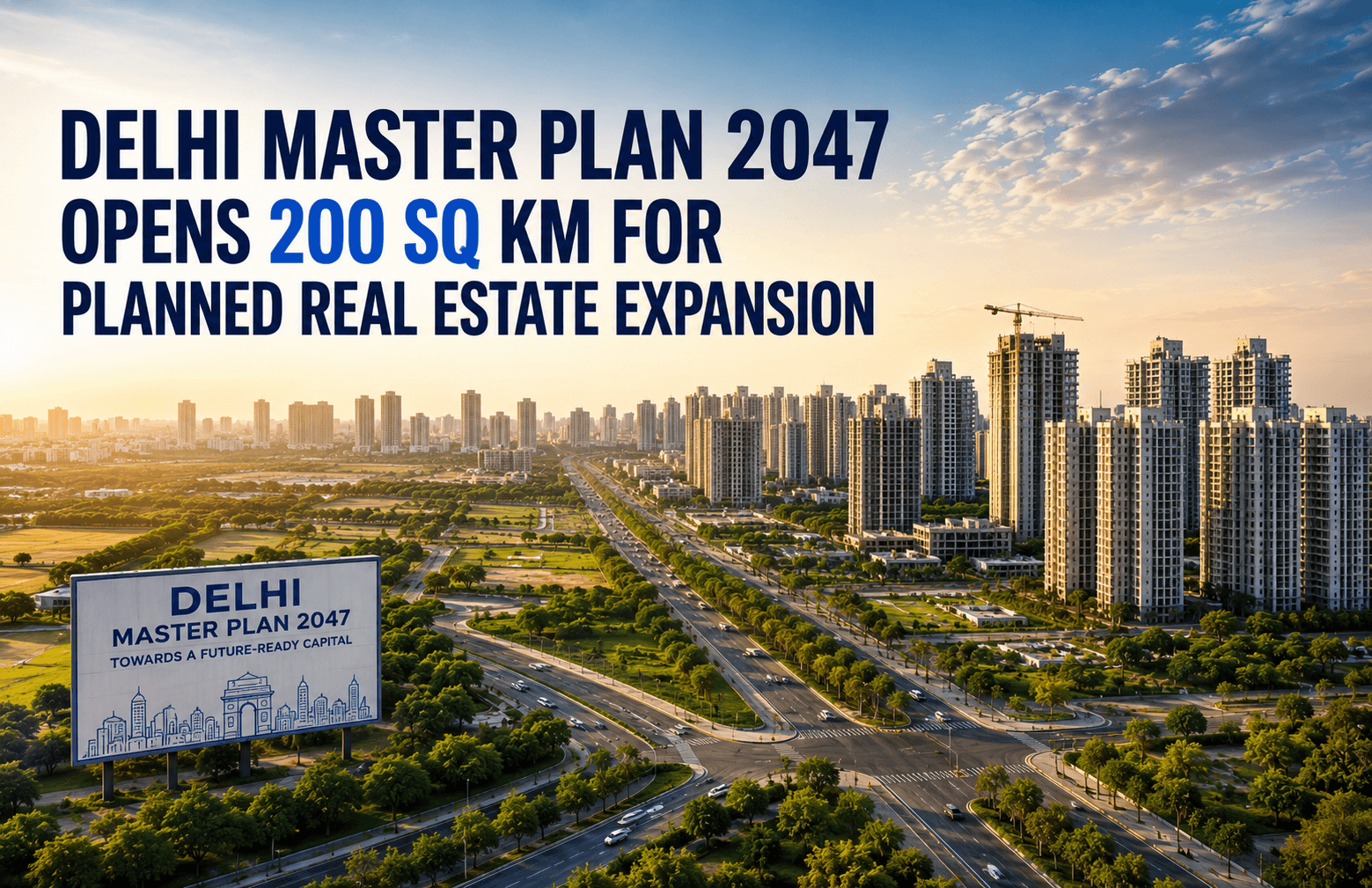
Delhi 2047: The Master Plan That Could Reshape the Capital
A new chapter for Delhi's growth, infrastructure and real estate
On 20 August 2026, the Master Plan for Delhi 2047 (MPD-2047) was officially notified — a long-term framework for how the capital will grow, regenerate and accommodate its future population. For property owners and investors, its significance goes well beyond infrastructure. It could change the way land is valued, developed and strategically acquired across Delhi.
From a Static City to a Dynamic One
Earlier master plans largely focused on land-use allocation and planned expansion. MPD-2047 takes a broader view, combining redevelopment, mobility, land assembly, environmental resilience and economic growth, with two approaches at its core: area-based redevelopment for existing built-up areas, and Right-of-Way-based planning for emerging, greenfield ones.
What It Means for Real Estate
Land pooling remains one of the principal instruments for unlocking large development areas, particularly in Outer Delhi, bringing fragmented parcels together into planned neighbourhoods with roads, infrastructure and community facilities. The revised framework introduces Town Planning Schemes to make assembly and implementation more practical. For landowners, this makes a parcel's planning status increasingly consequential: land without clarity remains simply land; land positioned within the right development framework can become a strategic asset.
Transit-Oriented Development gives Delhi's growth a direction to follow. The plan places real weight on compact, mixed-use districts around Metro, rail and RRTS corridors, integrating housing, employment, retail and transport. The principle holds: connectivity creates value, and properties near future mobility infrastructure may follow a very different trajectory from otherwise comparable ones.
Redevelopment of the existing city does the rest of the work, Delhi doesn't have unlimited vacant land, so much of its future growth has to come from regenerating what's already built. For older neighbourhoods, that opens the door to renewal, better land utilisation and improved connectivity. For owners, the question shifts from what is my property worth today to what could this property become under the city's future planning framework.
The Green Thread
Delhi's future isn't planned around buildings alone. MPD-2047 gives real weight to the city's green and blue infrastructure, the Ridge, biodiversity zones, drainage corridors, the Yamuna floodplain, and a proposed citywide park connector of roughly 152 km, alongside green buffers and a public greenway along parts of the Yamuna.
This matters more in Delhi than almost anywhere else. The city's premium neighbourhoods have always drawn their character from something hard to replicate, trees, parks, low density, open space, and this plan treats that not just as an environmental asset, but as a defining part of long-term real estate appeal.
Connectivity Isn't the Whole Story
The plan pushes Delhi toward a more transit-connected, less vehicle-dependent structure, with proximity to transport infrastructure carrying more weight in a location's long-term desirability. But connectivity alone doesn't define premium property. In established addresses like Vasant Vihar, Golf Links, Jor Bagh, Greater Kailash, Panchsheel Park, Neeti Bagh and Chanakyapuri, the value proposition still rests on the same combination it always has, address, privacy, neighbourhood quality, infrastructure and scarcity.
What It Means for Owners
The clearest signal MPD-2047 sends is that a property's future value won't be determined by size alone. Location, road width, land-use designation, redevelopment potential, surrounding infrastructure and applicable policy will all matter, which makes property-level due diligence more important than ever. "This area will benefit from the Master Plan" isn't a strategy; it's a starting point. The real questions are more specific:
- What is the current land use, and which planning policy applies?
- What is the road hierarchy and Right of Way?
- Does the property sit within a TOD, Land Pooling, High Density Corridor or Low Density Area?
- Are there exclusions or special regulations?
- What redevelopment potential genuinely exists?
These are the questions that separate a real opportunity from market speculation.
Our View
At Sagar Home, we've always believed Delhi real estate is a market of address, scarcity and timing. MPD-2047 adds a fourth layer: planning intelligence.
The right property isn't necessarily the one in the most talked-about location, it's the one where land, location, planning, connectivity and long-term demand intersect. As Delhi moves toward 2047, understanding that intersection will matter more with every significant property decision. The next chapter of Delhi real estate is already being planned; the opportunity belongs to those who read the micro-market before it becomes obvious.
A note for property owners and investors: MPD-2047 is a city-level planning framework, it does not automatically grant development permission to an individual property. Every property should be evaluated independently against its land-use designation, applicable development policy, road width, planning status and title, with professional legal, planning and technical due diligence undertaken before any significant acquisition or redevelopment decision.
Sagar Home South & Central Delhi's Trusted Luxury Real Estate Advisory Private advisory for acquisitions, confidential sales and strategic property decisions across South & Central Delhi.